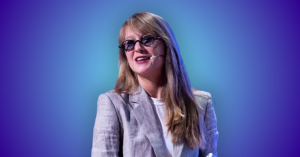


Last week, sustainability software company Plan A, with a Bulgarian founder at its helm, announced that it was acquired by Diginex (NASDAQ: DGNX) in an $80 million cash-and-equity transaction.
The aim? To bring together Plan A’s decarbonisation and ESG capabilities with Diginex’s RegTech and supply-chain expertise. The founder and CEO, Lubomila Jordanova, will remain in her role. In a conversation with The Recursive, Jordanova shared the experiences that led her to where she is today.
It was her early-founder conviction; the idea that if the mission was strong enough, the business would follow. Sustainability, after all, seemed inevitable. But years of building, selling, fundraising, and surviving taught her something more sobering.
“I think, from today’s perspective, I understand that businesses won’t commit to sustainability unless the value and return on investment are clearly explained.”
ESG is often misunderstood, which brings money challenges
“I think money was quite often central to how this industry was defined.”
Jordanova takes a pragmatic view of the sustainability sector. From the beginning, she saw how tightly it was bound to capital, incentives, and regulation. What helped her early on was timing.
“We actually had the chance to ride on the trend, right on the legislative shifts, there were a lot of opportunities that were externally defined,” says Jordanova.
Those shifts created space for new companies. “And I had the chance to tell a story that was fairly novel, and for at least some people, it was inviting enough for them to want to be part of this novel path for innovation, and the development of the tech industry.”
How did she manage to convince early investors? “The first investors in the company were my family,” Jordanova recalls. “You know, the whole concept of friends, family and fools definitely stood in place.”
Institutional money followed later, and selectively. “We attracted institutional investors who were either specialized in sustainability or focused solely on technology, particularly in the geography where we were operating (Germany) which helped us get them excited.”
But even then, education was constant. Investors didn’t arrive fluent in ESG.
“I can promise you, after 10 years of doing this, I’ve had to educate so many investors.”
ESG itself, she adds, is often misunderstood. The industry is really broad — it’s environmental, social, and governance, yet many founders narrowed their focus too much, building products for very small reporting niches.
The challenge, Jordanova argues, extends to management and investors alike. “Until the top story is not understood on a management level, you’re always going to have challenges with budgets,” she says, noting that many investors also lack deep familiarity with the space.
Years of easy capital, she adds, allowed weak ideas to persist, even though sustainability doesn’t function like standard software. “It’s not simply a marketing optimization tool,” she says — it requires ongoing work rather than one-off solutions.
With multiple offers on the table
Founded in 2017 by Lubomila Jordanova, Plan A was built around a clear mission to help businesses measure and manage their environmental footprint, a value proposition that gained strong traction during the peak of the ESG wave as companies rushed to comply with growing regulatory and investor demands.
“We had a lot of options on the table. I’m really lucky to say that we had 10 options. Some of them expected us to join another company and become the sustainability department.”
Others offered expertise, but at a cost. “Some of them invited us to be the expert in carbon accounting within a group of technologies that is mainly focused on ESG.” The decision came down to maintaining freedom over how the company would develop, staying true to its product and legacy, and recognizing the potential synergies.
Lubomila tells me that making a choice like this always means there are two ways to go, a familiar founder’s dilemma: should I stay or should I go.
“My co-founder, for example, left. I chose a different path — continuing to build within the new structure, with more responsibilities, for a period that’s different from what you typically see in venture capital.”
The conversation founders avoid
Jordanova says many founders hesitate to seriously consider acquisition talks early on, which she sees as a common mistake. She explains that being open to these conversations can reveal how quickly an industry is changing, as well as offer more stable options in a financially demanding environment.
“I remember when we got the first offer, it felt like the judgment call of your existence on this planet,” Lubomila says with a smile.
As she puts it, “I think you need to have the conversation,” she says, adding that founders also need to distance themselves from the emotional weight of offers. It feels like a price tag is being placed on years of your work but “you should eliminate this feeling,” she points.
From the outside, the exit looked like a clear success, but internally it came during a period of major personal change. “The last 12 months were really difficult,” Jordanova says. The turning point wasn’t the deal itself but becoming a mother. “That was a much bigger event,” she explains. Motherhood, she says, helped her reassess priorities and her place beyond work.
What comes next
Today, Jordanova finds herself in a new phase, focused less on independence and more on integration with the company that acquired Plan A.
Diginex is a publicly traded sustainability and regulatory technology company that provides software and advisory solutions focused on ESG reporting, climate data and supply-chain risk management.
“I’m particularly excited because now we’re getting closer to Diginex and understanding what their ambitions are,” she says. Their reach is also expanding, especially in Asia. Diginex operates as an investment holding business with SaaS products and advisory services used by companies and governments to streamline ESG reporting and related processes.