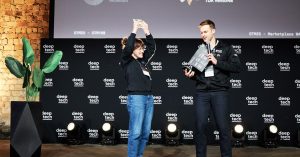

ViennaUP is framed around international dialogue. That translates into how effectively it connects people across markets and whether those connections evolve into sustained collaboration.
At the core of the platform is a deliberate concentration of international actors. Last year, ViennaUP brought together more than 15,000 participants from over 95 countries, alongside hundreds of startups and stakeholders joining through curated delegations.
For Gabriele Tatzberger, Head of Startup Services, and Dudu Gencel, Startup Services Manager at the Vienna Business Agency, the outcomes are embedded in how the platform is built: a decentralized format, strong international participation, and curated ecosystem partnerships ensure that global perspectives meet local substance.
That structure establishes the conditions for interaction, and the real impact is determined by how those exchanges extend beyond the event and translate into continued collaboration once participants leave Vienna.
“Dialogue creates value when it leads to trust, continuity, and real collaboration. That is where international dialogue becomes tangible, when people do not just meet, but continue building together,” says Alexis Eremia, Co-Founder and Managing Director at Impact Hub Vienna, the organisation behind Impact Days.
Nora Wolloch, Executive Manager at the World Summit Awards (WSA), describes dialogue as the entry point into a longer process of engagement, where the real objective is to convert initial encounters into ongoing collaboration. In her view, the value of ViennaUP lies in how these first interactions evolve into relationships built on shared context and continued exchange, rather than remaining isolated moments within the event itself.
Designing for depth and precision
ViennaUP’s scale creates a wide range of entry points, but the value participants extract depends on how deliberately they navigate it. Tatzberger and Gencel point to prioritization and selectivity as the determining factors, with an emphasis on targeted meetings and thematic depth over broad attendance.
This reflects a broader shift in how global networks approach large, distributed events, where focus and preparation shape outcomes more than attendance.
“Define two or three concrete goals, then focus on curated formats such as roundtables, matchmaking sessions, and smaller community gatherings,” says Wolloch.
From the Impact Days perspective, Alexis Eremia underlines the same principle, framing value as a function of being in the right conversations rather than maximising attendance across the programme.
Participants who arrive with clear objectives and a defined set of conversations tend to build stronger follow-through, particularly when those conversations are anchored in specific partnerships, capital needs, or market entry plans.
Coordinating a distributed platform
ViennaUP brings together more than 40 partners across 35+ events throughout the city, creating a system with multiple formats, audiences, and entry points operating in parallel. Tatzberger and Gencel describe this as a feature of the platform, where the diversity of formats reflects the individuality of each contributing ecosystem actor.
“To be very honest, a little bit of fragmentation is nothing to worry about. We value the individual spirit each event brings to the table.”
Coordination relies on alignment across partners rather than centralized programming, allowing participants to move across different environments while remaining anchored in a shared direction.
Extending interactions beyond the event
Formats such as Salon Future focus on smaller, curated environments designed to deepen interaction and build trust between participants. They prioritize continuity over visibility, creating space for more focused exchanges between actors who are likely to work together beyond the event itself.
By limiting scale and increasing relevance, they enable conversations that carry forward into follow-ups, partnerships, and longer-term collaboration, rather than remaining confined to the timeframe of the event.
What drives cross-border engagement
From WSA’s perspective, engagement across markets depends on a combination of trust, relevance, and accessibility.
“Cross-border engagement comes down to trust, relevance, and accessibility. People are more willing to step outside familiar ecosystems when there is a clear benefit, such as new markets, complementary expertise, or shared challenges,” says Nora Wolloch, Executive Manager at the World Summit Awards.
Networks like WSA contribute by establishing a shared baseline among participants, where alignment in values and expectations lowers the barrier to collaboration.
But cross-border engagement is also shaped by a more relational layer: the shift that happens when people move from institutional profiles and market labels into direct human interaction. In that setting, common challenges become easier to recognize, familiarity builds faster, and collaboration gains a stronger foundation than it would through formal introductions alone.
Navigating systems across markets
For impact startups, scaling across borders involves navigating regulatory frameworks, procurement systems, and capital structures that vary significantly between markets. Alexis Eremia, Co-Founder and Managing Director at Impact Hub Vienna, points to the need for alignment across these layers, where progress depends on access, trust, and the ability to operate within complex systems.
“Impact startups rarely scale on product alone. They scale through trust, access, and the ability to navigate complex systems.”
Additionally, Impact Days brings founders into direct exchange with investors, corporates, policymakers, and ecosystem actors, creating a shared context where these constraints can be addressed from multiple angles. This multi-stakeholder interaction becomes particularly relevant in sectors where implementation depends on coordination across several actors, rather than on product adoption alone.
Where capital is focusing
Investor attention within the impact space is concentrating on areas where both innovation and system-level support are required. Alexis Eremia points to a growing focus on sectors such as biodiversity, disability, and regenerative agriculture, where progress depends on longer time horizons and closer coordination between stakeholders.
“We see growing interest in biodiversity, disability, and regenerative agriculture… spaces where innovation is needed, but also where more patient capital and stronger ecosystem collaboration are essential.”
These priorities are reflected in the conversations taking place at Impact Days, where the emphasis shifts toward aligning entrepreneurs, investors, and institutional actors around the conditions required to make these sectors viable.
A working definition of international dialogue
Across Vienna Business Agency, Impact Days, and WSA, international dialogue emerges as a structured process that combines curated interaction, participant intent, and sustained follow-through for ViennaUp.
“Engagement happens when global becomes human and practical, when collaboration clearly helps move your work forward,” says Wolloch.
ViennaUP operates at the intersection of these elements, bringing together the actors and formats required to support cross-border collaboration beyond the event itself.