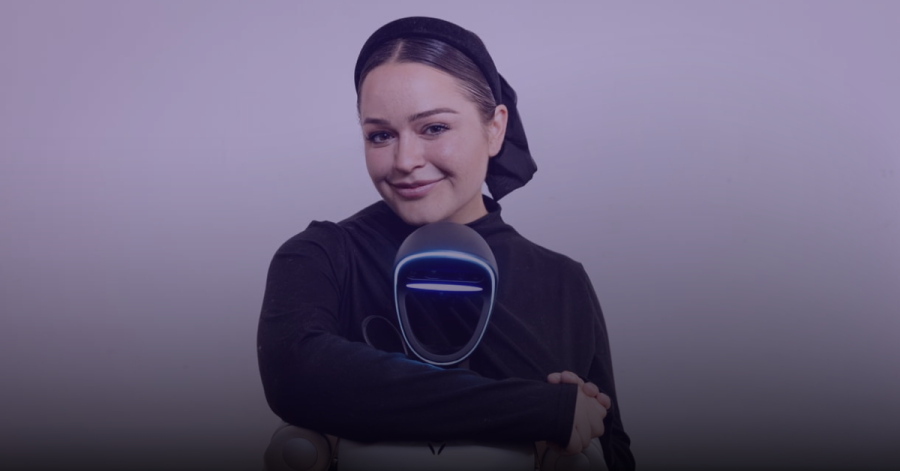

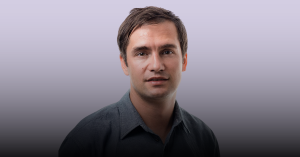
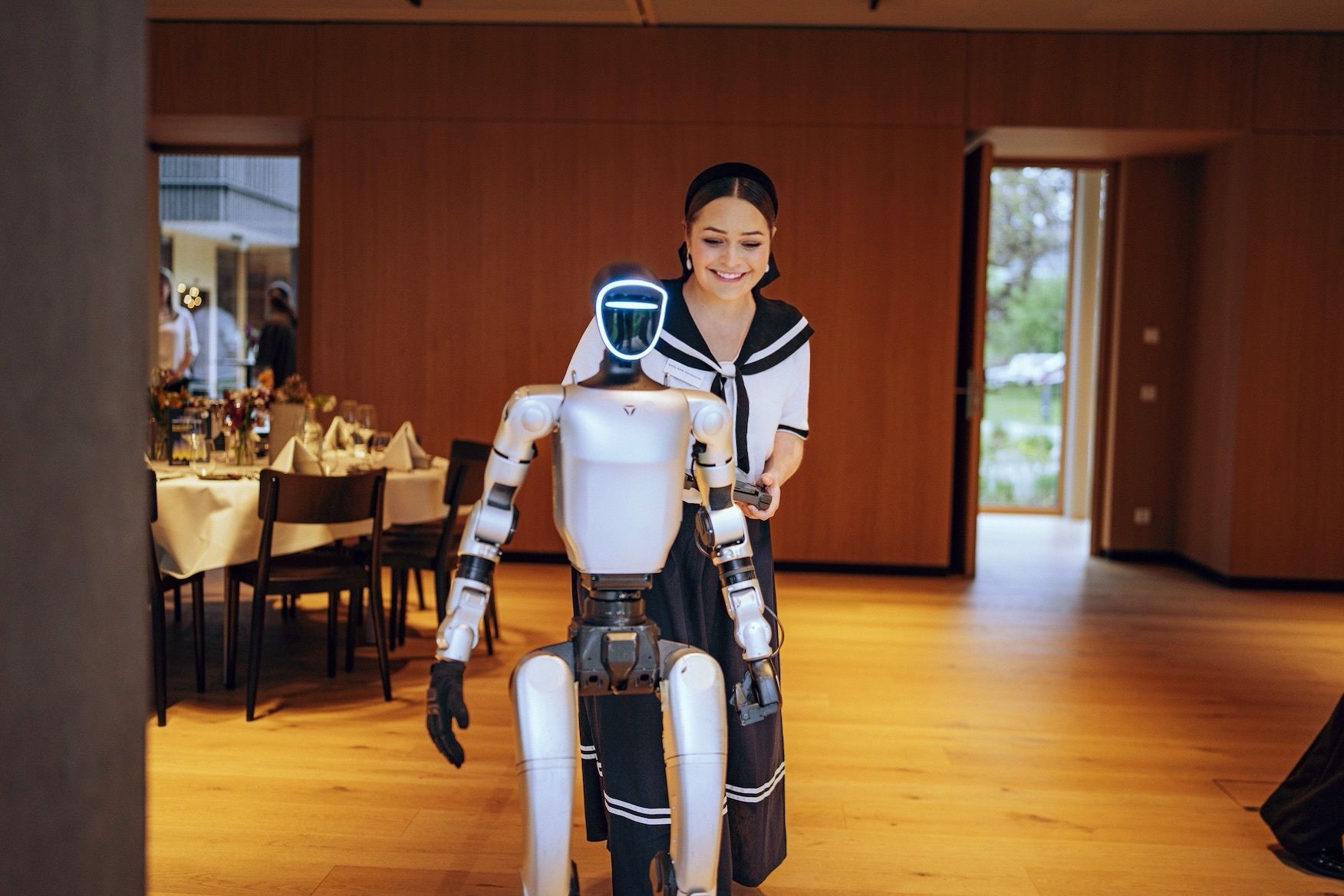
Most Mondays start with a sprint to clear an inbox. For Emily Kate Genatowski — an AI researcher, a historian, and the owner of a 1.3 meters tall humanoid robot named Tova — Monday began at 6:00 AM with a different kind of headache. The logistical nightmare of bringing the future into a world that isn’t quite ready for it.
Our biggest hurdles are not technical, but human
Over the past year, the tech world has become increasingly captivated by the promise of humanoid robots. Slick promotional videos showcase machines that can fold laundry, make coffee, and one day, perhaps, handle the drudgery of our daily lives. But while engineers focus on perfecting their motor skills and processing power, a far more complex challenge presents: getting society ready to live with them. This is the messy, bureaucratic reality that AI researcher Emily K. Genatowski is confronting head-on, not in a lab, but on the streets of Vienna.
Genatowski, a PhD candidate at the University of Vienna and a keynote speaker at the upcoming The Recursive CEE Forum, is pioneering a form of research she calls “tangible confrontation”.
By attempting to integrate her own humanoid robot, Tova, into daily life, she is systematically exposing the cracks in our legal, institutional, and infrastructural frameworks — proving that our biggest hurdles are not technical, but human.
From museology to AI
With a background that spans the Royal Academy of Dramatic Arts, a bachelor’s in history, and a master’s in museology, you might have asked yourself a question Genatowski often gets: “What is a historian doing talking about the future?” For her, the answer is obvious.
“The future is an open book test,” she explains. “We’ve been at every precipice before, and there’s always these wonderful analogies that we can look to.”
Instead of getting lost in technical jargon, Genatowski, a former leader at Google Arts & Culture, looks back to learn from the past. As we drive our cars today, we fail to reflect on the chaotic adoption of the automobile, which initially had no traffic lights, seatbelt laws, or even paved roads… A scenario that provides a great blueprint for the coming age of robotics.
“When a lot of people have them [robots] and we start to run into issues surrounding scalability, we’re going to have to update our infrastructure, similar to when we implemented traffic rules for automobile adoption, and then we’ll start to see where regulations really matter,” she says.
The thing is, as innovations advance, we don’t want to wait until that chaotic moment to start thinking along these lines.
“Here is a robot. The robot would like to take the train.”
That’s why Genatowski’s research moves beyond theory. Her method involves taking her robot, Tova, and placing it in everyday situations to force a response from unprepared institutions.
“It’s very hard to get institutions, government offices, or private businesses to engage in an abstract concept,” she says. “However, if one person very thoughtfully and very responsibly comes to them and says, ‘Here is a robot, the robot would like to take the train’, how will your institution decide its policy?”
The answer, so far, has been a mix of confusion, risk aversion, and bureaucratic inertia. After extensive inquiries, Genatowski was told Tova could ride the tram — but only if classified as baggage. Unwilling to accept this as a final answer, she has so far kept the robot off public transport. It’s a small, almost comical, example of a much larger problem she calls the responsibility gap.
The bigger problem? Currently, there is no “Bureau of Robotics” to dictate what happens if an autonomous machine causes damage or makes a mistake. Who is liable? The owner who didn’t instruct it correctly? The software developer who messed up the code? The manufacturer?
“Now the responsibility falls solely onto the owner of the system. However, the owner of the system did not program the system,” Genatowski points out.
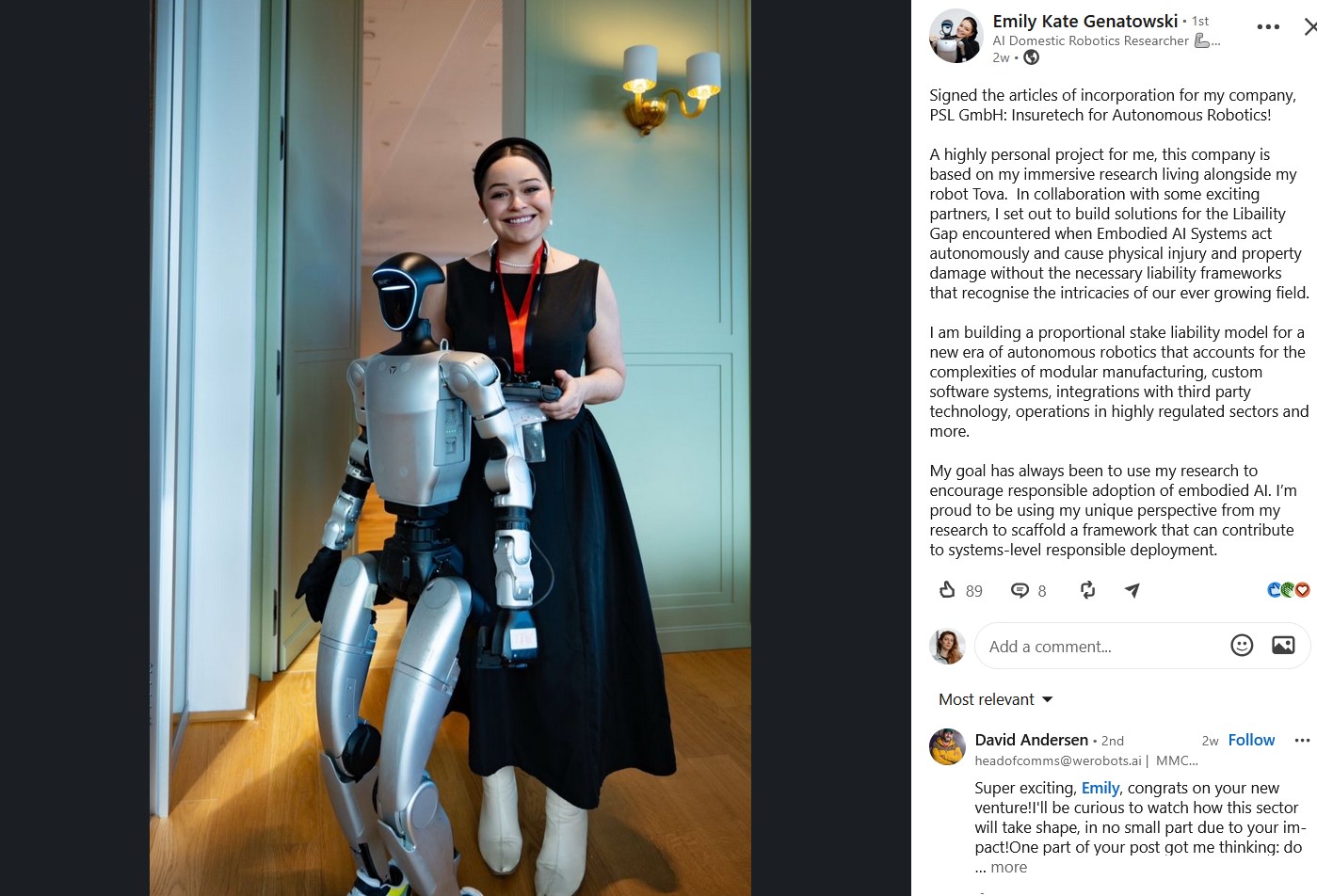
To solve this, Emily founded an insure-tech company, PSL GmbH, which developed a system of algorithmic proportionality to allocate liability across the entire chain of actors. Think of it as the antidote to the black box of autonomy in robots. When an incident occurs, the system mines a series of sensor readings and maintenance logs to analyse how much fault lies with the 5G provider, the developer, the manufacturer, or the owner who forgot to clean a sensor. But this requires a fundamental shift in legal thinking, moving beyond a binary view of responsibility, she concludes.
Can a robot buy flowers?
In another one of her tangible confrontations Genatowski took Tova to a local flower shop. The goal was to see if the robot could pick a bouquet and pay.
Cash was easy. Electronic payment? Not so much. “How do you prove that the user has authorized this?” she asks. She is currently in talks with three national banks to figure out the identity architecture of the future. Do we give robots credit limits? Do they need two-factor authentication? Questions kept piling up…
The first step, she argues, is simple: a registry and a formal identification system for robots, tethered to their owners, much like Austria’s digital ID framework.
“I’ve been told that registry in Vienna is only for biological humans, which is absolutely fine… However, I do think we need to start expanding the way that we think.”
Do we really need a robot butler?
During our conversation, we also opened up a curious case of why we are making our robots humanoid. Genatowski suggests our obsession with the human form might actually be holding us back.
“We have grown up on these incredible sci-fi stories,” she reflects, referencing characters from The Jetsons to Star Trek. “And I think it’s actually causing us a disservice.”
She argues that our reluctance to adapt our physical spaces is a historical anomaly. We rewired our homes for electricity and replumbed them for washing machines, yet we now expect robots to adapt perfectly to us.
A more practical solution, she proposes, might be to embrace industrial-style automation in dedicated utility rooms rather than waiting for a flawless bipedal robot that can navigate our cluttered living rooms.
Living in Europe adds another layer of complexity to all of this. While a robot in another territory might be always on, collecting data 24/7, Tova is a model of GDPR compliance. It has a limited battery life and doesn’t even recognize the person it lives with to avoid storing biometric data. This makes Tova safe, but also significantly less useful than a simple smart home device, like a pet camera.
“You can have the most sophisticated robot of all time and if it can’t cross the street, what good is it?”
Looking back from 2056
Ultimately, Genatowski is convinced that the path to a robot-integrated utopia, rather than a dystopian surveillance state, will be paved with the dry but essential bricks. And it depends on how we handle these dry topics like insurance, taxation, and ID cards today. If we wait until the robots are fully ready to regulate them, we’ll be playing a permanent game of catch-up.
Alas, future generations will likely look back at this moment with a sense of wonder and amusement. “I think that it is going to seem insane that I was begging the government to register my robot and they kept saying, ‘No, no, no, we only look for humans’,” Genatowski says with a laugh.
Much like we view the first clunky iPhones or the early days of the automobile, they will see the gap between our futuristic ambitions and our primitive reality. “I think they’ll probably be chuckling as well.”