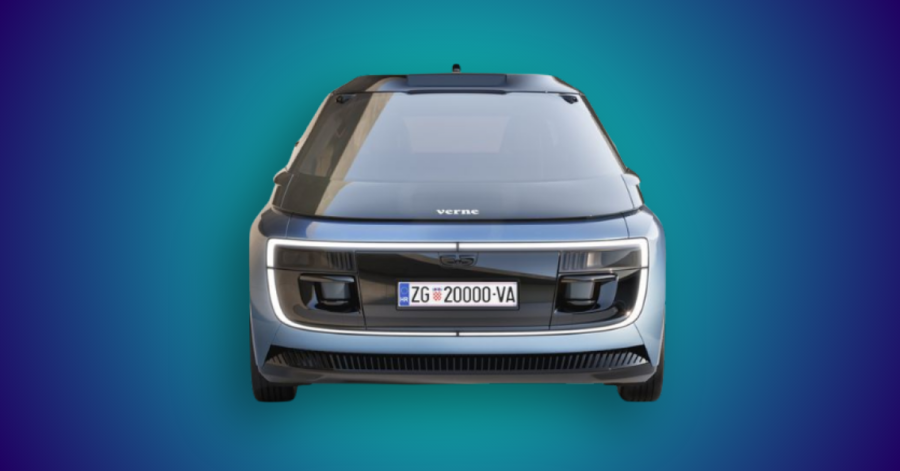


The reveal of Verne almost two years ago, a Croatian bet on urban autonomous mobility, still feels fresh to me. It was a glimpse into the future as much as a harsh reality-check.
Despite impeccable UX and design imbued in every inch of Rimac’s robotaxi, on the day of the big reveal at the Rimac campus, when Mate gave the call — the car didn’t budge.
Verne stood at the stage, bare and frozen, waiting for its autonomy to happen.
And then that autonomy did appear. From the first row, barely noticeable before, a man. After an uncomfortable few minutes of Verne being still, he propped up, now visible to all the audience, with a joystick in his hand — flustered that his toy wouldn’t start.
Soon after, a few others emerged from around the big curtains, looking confused, checking in disbelief around and inside the car, as if it were some alien species or, rather, a robot that turned defiant.
Many chuckled at the sight, but the aftertaste was bittersweet for a couple of reasons.
The Backlash
First, many wondered how something like this could happen to a company that probably spent thousands of euros on this reveal.
Then another layer peeled off and people were starting to feel resentful: Why did this project secure ~ €180 millions of EU grants…
Another: Why have they promised full autonomy when there is a guy with a joystick there?
Our region is good at pointing fingers, and being unforgiving. Many Croatians surely didn’t miss the opportunity after this flop. The fog seller label, a national idiom for someone who sells promises, resurfaced online. The credibility damage was palpable.
Many publicly doubted the project would ever reach the road. Questions piled up, and it surely wasn’t pleasant, but to a large extent it was well justified.
This disbelief started already in 2021, when Mate Rimac spoke at his campus alongside President Ursula von der Leyen. The promise was visionary and bold:
a fleet of fully autonomous robotaxis, Level 5, no steering wheel, no pedals — roaming the streets of Zagreb by 2024.
The Promise
How did it all start? The project (then known as Project 3 Mobility) was backed by the National Recovery and Resilience Plan (NPOO), which secured them staggering €179.5 million in EU grants. One of the conditions for receiving this money was the development of a fifth-generation autonomous driving system.
By some, this was considered as a game-changing investment in Europe’s Elon Musk. On the other hand, critics shouted about the lack of a public tender. In the end, the government doubled down, labeling it a strategic national interest.
Almost 2 years flew by. In 2023, the silence from the P3M headquarters began to feel heavy. The 2024 deadline, once a distant milestone, was suddenly around the corner, yet there was no infrastructure in sight, no Mothership hub at the Adriatic Bridge in Zagreb, and no visible cars.
Then the first major move occurred in June 2024. P3M announced rebranding to Verne, and the mentioned launch event was supposed to be a triumph, setting a new course for the project. Instead, it became a meme. The 2024 deadline was officially buried, and the company pushed it back to early 2026.
So, 2025 was the year when the Verne team had a moment of respite. However, another milestone hit them right back. They officially announced they plan to outsource development of the autonomous technology, or the brain of Verne. One of the main things that secured them EU funds. (At this point, any updates coming from Verne were scrutinized heavily.)
Even though outsourcing development of autonomous driving makes total sense (Rimac pioneered car engineering and batteries more then machine learning), this didn’t help the project’s already damaged reputation. Once again, they threw themselves under the bus with untimely communication, story-making, and lack of transparency. During this process, the goal of Level 5 autonomy (driving anywhere, anytime) was quietly downgraded to Level 4 (driving within specific, pre-mapped zones).
All the while, the robotaxi factory began to rise in Lučko, funded by private capital, Verne began integrating established tech from global players step by step. In late November 2025, Mate Rimac published a video showing Verne robotaxi prototypes at various stages of development, acknowledging that “it seemed crazy to do such a story from Croatia” while drawing a parallel to the development of the Nevera electric hypercar, a project that also looked improbable until it wasn’t.
By the end of 2025, they had 60 prototypes, but they also weren’t the autonomous pioneers the 2021 brochures promised.
The Comeback
And here we are, 20 months after the flop launch, and 3 months after the announcement that robotaxis would appear on Zagreb’s roads in the spring of 2026. And they did.
On March 26th, Chinese autonomous-driving firm Pony.ai, ride-hailing giant Uber and Croatian mobility company Verne announced plans to deploy Europe’s first commercial robotaxi service in Zagreb.
The three companies divided the roles precisely. Pony.ai supplies its autonomous driving solution — the Gen-7 system, deployed on its Arcfox Alpha T5 Robotaxi. Verne acts as fleet owner and service operator, coordinating regulatory approvals and day-to-day operations across both networks. Uber integrates the service into its global ride-hailing platform, complementing Verne’s own customer-facing app.
Of course, the announcement was followed by a promise — this time, thankfully for the trio, a vague one: The partnership aims to deploy a fleet of thousands of robotaxis across European cities over the next few years.
Preparations for fare-charging services are already underway, they confirmed; and Pony.ai’s Gen-7 system began public-road validation in Zagreb.
Beyond platform integration, Uber intends to invest in Verne as a strategic partner, adding financial weight to the expansion plan, while Pony.ai brings a track record that anchors the credibility of the whole arrangement. Its Gen-7 system has already reached unit economics breakeven (the point where each ride covers its own costs) in Guangzhou and Shenzhen.
The Verdict
While the Verne project has successfully avoided collapse, it has transformed from a homegrown miracle into a complex integration of global parts. And that would be totally fine if it wasn’t hyped as the first, securing millions from the EU for something it didn’t deliver.
On that note, the original deadline for the R&D phase of the project has hit a wall once again. Verne has requested yet another extension few days ago, aiming for August 31, 2026, to justify the EU funds already spent. However, the biggest news of the week wasn’t a delay; it was the partnership.
And don’t get me wrong, this project and partnerships are very significant. Zagreb’s emergence as Europe’s first commercial robotaxi city would represent a genuine milestone for the CEE startup ecosystem.
Yet, things never go as smoothly as PR wants us to believe. Regulatory approval from European authorities is still pending, while the company has not disclosed which specific neighborhoods in Zagreb will see the first deployments, nor the precise timeline for opening the service to the general public.
An initial phase limited to Verne employees is expected before public access opens, and the decision on broader availability will likely depend on the results of that restricted testing period. For context, Waymo — the most commercially advanced robotaxi operator globally — now completes roughly 450,000 paid rides per week across several US markets. That scale took years of sustained regulatory engagement in each city.
The question left is: how quickly can Verne navigate European regulatory frameworks and convert testing into a paying service that ordinary riders actually use?