
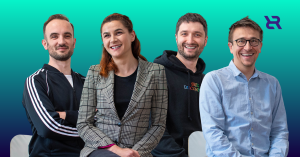
After 11 years of serving 50M+ users, Mobile Wave Solutions has seen every CTO challenge up close. Here’s more about their expertise.
While the European tech world discovered “nearshoring” as one of 2025’s hottest buzzwords, one British-Bulgarian team has been quietly perfecting it for ten years.
Mobile Wave Solutions, operating dual headquarters in London and Sofia with a 150+ person engineering & business development team, is a reputable software company specialising in cross-border tech collaboration. Over the years, Mobile Wave Solutions has yielded a 92% client retention rate across high-stakes sectors including fintech, healthcare, hospitality, and payment infrastructure, where production failures carry immediate consequences.
To mark their tenth anniversary, Mobile Wave Solutions’ team has distilled a decade of lessons into a CTO insights guide, shared exclusively for the first time with The Recursive. We sat down with MWS to understand what truly keeps technical leaders up at night and what strategies could earn us some sleep.
What emerged was a frank conversation about the five pain points most CTOs face when looking for nearshoring partners, and why most companies are solving the wrong problems entirely.
Lesson #1: AI is a tool for reallocation, not replacement — speed comes from working smarter, not harder.
The role of a CTO in 2025 requires doing more with less: ship faster, cut costs, and open new markets. But the old wisdom was “pick two: fast, cheap, or good.” The new wisdom might tell us “AI lets you have all three!”
Both are wrong. Speed without quality creates technical debt that eventually slows you down more than the initial velocity helped. Quality without speed means you’re too late to market and your perfect product is irrelevant. Mobile Wave Solutions has spent the past two years learning how to thread this needle.
“In the past, building a proof of concept meant long cycles—brainstorming, refining requirements, implementing, then gathering client feedback,” Gabriela Alexandrova, Engineering Manager at Mobile Wave Solutions, explains. “With AI tooling, we can move from concept to prototype much faster. AI accelerates requirement drafting, code scaffolding, and documentation, allowing developers to focus on refining logic and delivering value rather than repetitive setup tasks.”
But here’s the critical part: speed didn’t come at the expense of quality. It came from reallocating quality efforts.
“Of course, AI isn’t perfect,” Gabriela continues. “It can generate code that looks right but doesn’t fit our architecture or business context, so human review remains essential. But overall, it has shortened our PoC delivery time dramatically and improved collaboration between product and engineering by giving everyone a tangible starting point much sooner. – explains the software pro – With AI tooling such as GPT and Copilot, this process has changed significantly. ”
According to Google Cloud’s 2024 State of DevOps Report, elite-performing teams deploy 973 times more frequently than low performers while maintaining sub-15% failure rates. The differentiator? Cultural practices around testing and continuous improvement, exactly what MWS has built.
Lesson #2: Product teams beat feature factories every single time.
Most CTOs have offshore scar tissue. They’ve hired “distributed teams” that turned out to be anonymous coders who never asked questions and vanished after six months.
“When clients come to you now, what do they misunderstand about nearshoring?” I ask Irina Stoyanova, Mobile Wave Solutions’ Commercial Director
“That engineers won’t care about the product and are just there to code features as written.We don’t provide ‘feature factories’; we build product teams. That’s how we form long-term partnerships that actually last and how we ensure strong people retention,” Irina explains. “When you hire intelligent people, they don’t find joy in mindlessly working through tickets. Everyone needs to feel part of what they’re building and see a sense of purpose in their work.”
“That our engineers wouldn’t dare share their opinion openly and would simply agree with everything requested.” She laughs. “At this point, I usually think – wait until you meet them! That couldn’t be further from the truth. We actively encourage open communication and constructive challenge.”
There’s no ‘us versus the client’. That’s what makes collaboration real and that’s how better products get built.“
While European tech averages 13.2% annual employee turnover per LinkedIn’s 2024 data, MWS’s retention tells a completely different story, with partnerships dating back to 2015 and still thriving.
Lesson #3: Optimize for capability – transparency and focus deliver real ROI.
CFOs love the nearshore pitch deck: “Same quality, 50% cheaper!” CTOs know it’s never that simple.
The spreadsheet shows immediate savings. The reality is that six months later, they often tell another story: miscommunication, missed deadlines, and quality issues that eat through budgets. According to Deloitte’s 2024 Global Outsourcing Survey, 64% of companies listed “hidden costs” among their top three outsourcing challenges, from communication overhead and rework to knowledge loss caused by high turnover.
“The companies doing nearshoring for cost are optimizing for the wrong metric,” says Omid Rezvani, Mobile Wave Solutions’ CEO. “The ones doing it for capability are the ones who actually see ROI.”
This is precisely where Mobile Wave Solutions takes a different stance. As Business Development Lead, Radinela Dimitrakova explains, “I understand where concerns about double-billing and shadow engineers come from; unfortunately, those are common practices in large outsourcing companies. What I always say is: we operate with integrity and transparency.”
The economics back that up. Unlike volume-driven offshore providers that chase utilization rates and stretch engineers across multiple clients, MWS is built for focus and trust. The only way to build trust through a remote team here is through transparent pricing that ensures engineers are dedicated to single teams—no hidden hours, no juggling projects.
Lesson #4: Integration is a design problem that requires intentional process, not proximity.
The hardest part of nearshoring is integrating engineering talent into client projects and still making them feel like they’re building their own product.
Most companies assume integration is automatic and requires you to “just add them to Slack and they’ll figure it out.”
But integration is a cultural issue and if you don’t design for it from day one, you end up with siloed teams, duplicated work, and engineers who don’t know why they’re building what they’re building.
Mobile Wave Solutions solved this problem architecturally – literally, with their dual-hub structure across Sofia and London. But presence across Europe alone doesn’t create integration. Process does.
“For us, staff augmentation isn’t a temporary fix, we look at it as a long-term collaboration model,” Radinela explains. “Almost all our partnerships follow this approach, but within it, we operate using Scrum and agile principles. Our engineers aren’t just extra hands on the keyboard. They’re product-oriented professionals who take part in research, contribute ideas, and help shape data-driven decisions.”
What does this look like in practice?
Engineers embedded directly into the client’s ecosystem: same daily standups, same sprint planning, same retrospectives, same backlog. The only difference is geography—and even that matters less than it used to.
“In our experience, there is little difference between British and Bulgarian work ethics,” Shahin Rezvani, Business Development Manager in the UK says. “Bulgarians are diligent and loyal, and we find British culture is similar in that sense: if individuals are respected and treated with care, they will do everything in their power to contribute to the team’s growth. Both value craft, both value honesty, both expect mutual respect.”
Lesson #5: AI kills the ticket-mover, not the engineer, so amplify talent, don’t automate it away.
“Every CTO is being pressured to ‘use AI’ – but what does that actually mean in your day-to-day development process?” I ask Gabriela.
“For us, using AI isn’t about chasing a trend. It’s about working smarter and focusing people’s time where it truly makes a difference,” she responds. “In our day-to-day work, AI helps us eliminate repetitive tasks, speed up delivery, and improve quality, so our engineers can focus on solving the complex, business-critical challenges.”
MWS has been integrating AI tools since 2023, and the results are striking. “A task that would take 2 hours of staring at an internal service can sometimes be reduced to 20 minutes, because the AI can summarize patterns and propose something usable,” explains Roberto Tsvetanov, another key software engineering manager.
But here’s where it gets interesting. “AI does not understand context the way a senior engineer does,” Roberto Tsvetanov continues. “It can suggest code, but it can’t be accountable for the impact of that code in production, with real customers, real money, real regulation, and real uptime expectations.”
According to GitHub’s 2024 research, 92% of developers now use AI coding tools. But the real question, Roberto argues, ultimately comes to human judgment.
His conclusion is sharp:
“I don’t think AI kills the developer role. I think it kills the idea of a developer who only ‘moves tickets from left to right.’ The future engineer is less of a ‘code typer’ and more of a technical decision-maker.”
“The companies that will fall behind are the ones treating AI like a replacement for talent. The companies that will pull ahead are the ones treating AI like an amplifier for talent.”
The Bigger Picture
This company’s story mirrors something larger: the structural evolution of outsourcing services globally thanks to connectivity. Central and Eastern Europe now has 3.5 million ICT specialists: a talent pool rivaling the UK and Germany combined, and Bulgaria is greatly appreciated for its software and mathematics decades of legacy.
“The advantage of being in Bulgaria is focus. We can scale fast without sacrificing standards, because the talent pool here is deep and ambitious, and the culture values long-term craft over short-term output. “
The proof is loud and clear: “a 92% client retention rate and relationships that go back to our founding. For most of our partners, Bulgaria stops being a question after the first project. They realize the real differentiator isn’t cost or location, but the level of ownership and thinking our people bring.”
According to Atomico’s 2024 State of European Tech report, cross-border tech collaboration within Europe increased 43% from 2020-2024, with nearshore partnerships growing fastest.
After a decade, what has Mobile Wave Solutions learned?
Omid reflects: “We’ve been doing this since before it was a trend. Now that everyone’s paying attention, we’re focused on what’s next: AI-augmented teams, deeper domain expertise, and helping CTOs build better, not just faster.”
That’s one way to tell a story about a “first-mover” advantage.