

Inflammaging in Clinical Practice: Bringing the Science to Clinicians
Two decades before longevity became a venture-backed category, Gordan Lauc, a leading professor of biochemistry and molecular biology, was working on a problem few outside academic biology were paying attention to.
From his base in Zagreb, he focused on glycans, complex sugar structures attached to proteins that play a critical role in regulating the human body. At the time, glycobiology was a niche field, often overshadowed by genetics and proteomics, and rarely discussed beyond specialist circles.
Lauc’s early work set out to change that. He brought inflammaging in clinical practice. What began as a research effort to better understand how glycans influence immune function and aging gradually expanded into one of the largest glycobiology programs globally. Over time, that scientific foundation became the basis for a broader ambition: translating glycan research from the lab into tools that could inform real-world health decisions.
“To really understand immunology, we have to include glycans to see the whole picture,” Lauc says. “And this is what GlycanAge is doing.”
A field with promises
For Lauc, the problem isn’t that longevity science lacks potential; it’s that it lacks rigor.
“The entire longevity field is filled with unvalidated products, unvalidated tests, and more or less snake oil,” he says. “Most of the things that are being sold… are marketing-based.”
Lauc draws a sharp line between what he considers science-led medicine and what he sees as commercial opportunism.
“We are trying to really deliver things that work, which are science-based,” he adds. “We are not primarily profit-driven… We will never make money a priority.”
That stance positions GlycanAge as something of an outlier: a company trying to translate decades of academic research into measurable health signals, without overpromising what those signals mean.
The missing layer in immunology
At the heart of that effort is a scientific gap Lauc believes has been overlooked for decades.
“Most proteins in the immune system are glycosylated,” he explains. “They carry glycans – complex sugar structures added after the protein is formed. Unlike proteins, glycans are not dictated by a single gene but are shaped by a coordinated network of genes and cellular pathways. This makes them highly dynamic, able to respond to lifestyle and environmental influences, and central to regulating how proteins function.”
Despite this, glycans remain underrepresented in mainstream immunology research. “Because they are complicated, many scientists just ignore them.”
That omission matters. Glycans are dynamic; they change with age, environment, and lifestyle. And according to Lauc, they are key to understanding inflammaging, the chronic, low-grade inflammation associated with aging.
The term itself was coined by Claudio Franceschi, one of the early pioneers in glycobiology. But while inflammation has become a popular concept in both medicine and consumer wellness, its measurement has lagged behind.
The term inflammaging, describes a chronic, low-grade, systemic inflammatory state that develops with age, even in the absence of infection. It is now widely recognized as a core biological feature of aging and a major risk factor for morbidity and mortality, with most age-related diseases sharing an inflammatory component.
From concept to measurement
For years, “inflammation” has been a catch-all explanation for everything from fatigue to chronic disease. Population studies further show that higher systemic inflammation correlates with impaired metabolic function and can interfere with processes like insulin signaling, linking inflammaging directly to metabolic disease pathways. But as Nikolina Lauc, co-founder and CEO of GlycanAge, points out, it has also been highly vulnerable to marketing.
“Suddenly everything became anti-inflammatory — supplements, foods — but there’s actually no way to measure it,” she says.
That’s where glycan-based biomarkers come in. Unlike acute markers like CRP, which fluctuate with short-term changes, glycan profiles reflect long-term immune system behavior. “It is a marker of long-term inflammation, not the daily variation,” Nikolina explains.
That distinction matters. It gets at a problem the longevity field has yet to solve: how to measure what it claims to improve. “Is this diet actually anti-inflammatory for this person?” she asks. “Will it change their health? Now we can measure that.”
The “threshold moment” in health
One of the most compelling ideas emerging from GlycanAge’s work is what could be called the threshold problem — the moment before disease becomes visible, but after biological processes have already shifted.
“You don’t know that you’re doing this damage on a biological level,” Nikolina Lauc says. “And then when you get feedback, it’s already at the point where you have symptoms.”
That is the window GlycanAge is aiming at: the early detection of where a person’s health is heading. “We have tools to measure health while we’re still healthy.”
The implications are significant. Instead of waiting for disease, individuals could monitor how lifestyle, stress, diet, or medication affects their long-term inflammatory state, potentially years before clinical symptoms appear.
Personalization over population averages
At its core, the approach is a shift away from relying on the idea of an “average patient.”
“You take a thousand people and divide by a thousand, that’s the standard human,” says Gordan Lauc. “This does not exist.”
In practice, this means that interventions — whether supplements, diets, or drugs — rarely work uniformly. “Many of these supplements… are probably actually working,” he says. “For one person. For 15% of people. But do they work for me?”
The only way to know, he argues, is measurement. “I have to check. I cannot wait to see when I will die to know if something worked.”
Why now?
If science has been developing for decades, why is it becoming relevant now? According to Nikolina Lauc, three shifts have converged. First, there is growing scientific validation: aging is no longer seen as a fixed process, with research over the past five years increasingly ց that it can be modified.
At the same time, clinical momentum is building, as areas such as epigenetic therapies, weight-loss drugs, and hormone replacement therapy are reframing aging as something that can be treated and managed. Layered on top of this is a broader cultural change, accelerated by the COVID-19 pandemic, that has heightened awareness of baseline health and immune resilience, pushing preventive health further into the public spotlight.
“People realized that being healthy is a good investment,” says Gordan Lauc.
The company is working toward regulated diagnostics — tools that could be used routinely in clinical settings to guide treatment decisions.
“You try an intervention, test again after three months, and see if it works for you,” he says. “If not, you try something else.”
In parallel, the company is collaborating with hospitals on disease-specific applications, including cardiovascular event prediction and diabetes risk assessment.
A new clinical lens on aging
Some of the strongest signals emerging from glycan research are tied to specific life stages and interventions.
Menopause and HRT
“Menopause doubles your rate of aging as a woman during that period,” says Nikolina Lauc.
Estrogen, she adds, appears to have protective effects across multiple health outcomes.
Weight loss
Framed not as cosmetic, but as “longevity medicine,” with measurable effects on immune aging.
Psychological health
“Psychotherapy can have as much of an impact as a drug,” she says, pointing to growing evidence linking stress and immune function.
Together, these insights suggest a broader shift: aging as a system influenced by biology, behavior, and environment.
The bigger shift
At its core, GlycanAge is advancing a more measured proposition: that aspects of health can be tracked and adjusted before disease becomes apparent, based not on individual data.
“Traditional healthcare is not here to keep you healthy,” Nikolina Lauc says. “It’s here to treat disease.”
What comes next, if their model holds, is something closer to feedback-driven medicine, where interventions are tested, validated, and personalized in near real time.
Building from CEE
While much of the longevity industry is centered in the U.S., GlycanAge’s scientific roots are in Croatia. “You can do world-class science from Zagreb,” says Nikolina Lauc.
Through collaborations with institutions like Harvard, Mayo Clinic, and Northwestern, the company is positioning itself as a bridge between regional innovation and global clinical practice.
Bringing the science to the clinic
On June 20th, that bridge becomes a room.
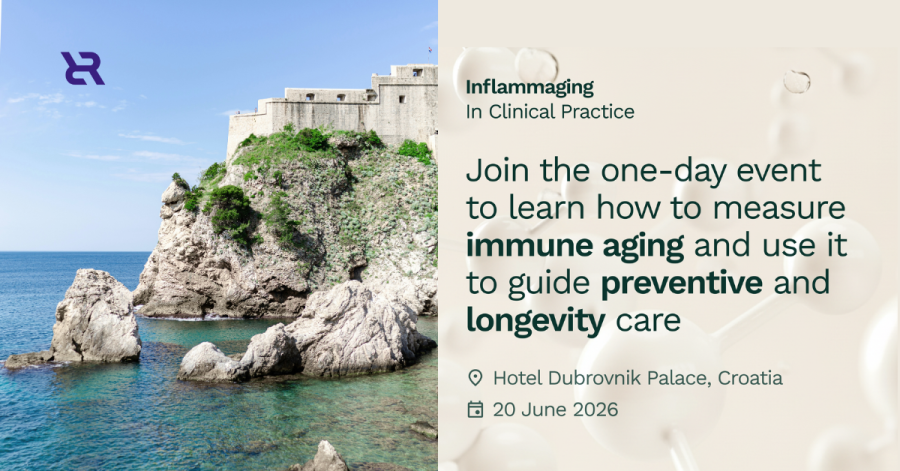
GlycanAge is hosting Inflammaging in Clinical Practice, a one-day satellite event in Dubrovnik, co-organized with ISABS and Mayo Clinic.
The audience is deliberately different from that of a standard scientific conference: the focus is on clinicians and practicing doctors, not researchers, and the agenda reflects it. The goal is not to present more papers, although groundbreaking research is available. It is to translate what the science already shows into tools, frameworks, and workflows that can be integrated into everyday practice.
What makes the gathering exceptional, beyond the calibre of attendees, is the data being brought to it. A significant portion of the findings to be presented have not been published before — some are at the pre-print stage, others represent clinical evidence still a year away from formal publication. “A lot of it is first edition,” Nikolina Lauc says. “You’re going to be able to see it in June.”
Prof. Claudio Franceschi, who coined the term inflammaging, is among the speakers. So are physician-scientists who have been applying this research in clinical settings for decades. The distinction matters: this is not a conversation about whether inflammaging is real. It is a conversation about what to do with it.
“There is enough scientific and clinical evidence now,” Nikolina says.
“It’s the right time to apply it.”