

The Czech startup ecosystem is approaching a critical threshold. A new investor survey conducted by investment firm DEPO Ventures, in cooperation with the Czech Startup Association and ecosystem partners, suggests that investor activity is weakening as market liquidity slows and fewer new investors enter the market.
The findings show that the share of first-time investors has declined significantly, while roughly one third of existing investors plan to reduce or halt their investment activity this year. Investors cite low market liquidity, a shortage of high-quality startup opportunities, and weak investment infrastructure as the main barriers to growth.
At the same time, the sixth edition of the survey highlights several potential solutions, including better access to ecosystem information, stronger knowledge sharing among investors, and systemic support such as tax incentives.
The survey was conducted in January and February 2026 through an online questionnaire and includes 172 responses, including 105 startup investors and 67 respondents who do not currently invest in startups.
Partners of the survey include the Czech Startup Association, the business and investment development agency CzechInvest, technology-focused law firm Novalia, consulting firm Deloitte, and the data startup Lakmoos AI.
Investor sentiment signals a cooling market
Investor sentiment in the Czech startup ecosystem is becoming increasingly cautious.
According to the survey, 33% of existing investors plan to reduce or stop investing in 2026, and nearly one fifth (19%) do not plan to make any startup investments at all this year. This represents a sharp increase from 2024, when only 4% of investors expected to remain inactive.
Another significant shift is the declining number of new investors entering the ecosystem. The share of first-time startup investors has fallen from 35% to 14% over the past two years. The steepest decline has been among angel investors, where the number of newcomers has dropped by 78% since 2022.
The survey also reveals a growing divide among investor groups. Professional investors — particularly general partners of venture capital funds — remain relatively optimistic, with 41% planning to increase their investments this year. By contrast, private investors are taking a more cautious approach and largely adopting a wait-and-see strategy.
More than half of limited partners (51%) who invest in VC funds say they plan to reduce or completely halt their investment activity, raising concerns about the ecosystem’s ability to sustain long-term growth.
Capital is available, but market dynamics are slowing
Despite the slowdown in investment activity, the survey suggests that the Czech startup ecosystem is not suffering from a shortage of capital.
Instead, investors point to structural challenges within the ecosystem itself. The most frequently cited barrier is the lack of high-quality startup opportunities, mentioned by 52% of investors. This is followed by low market liquidity and a limited number of exits (45%).
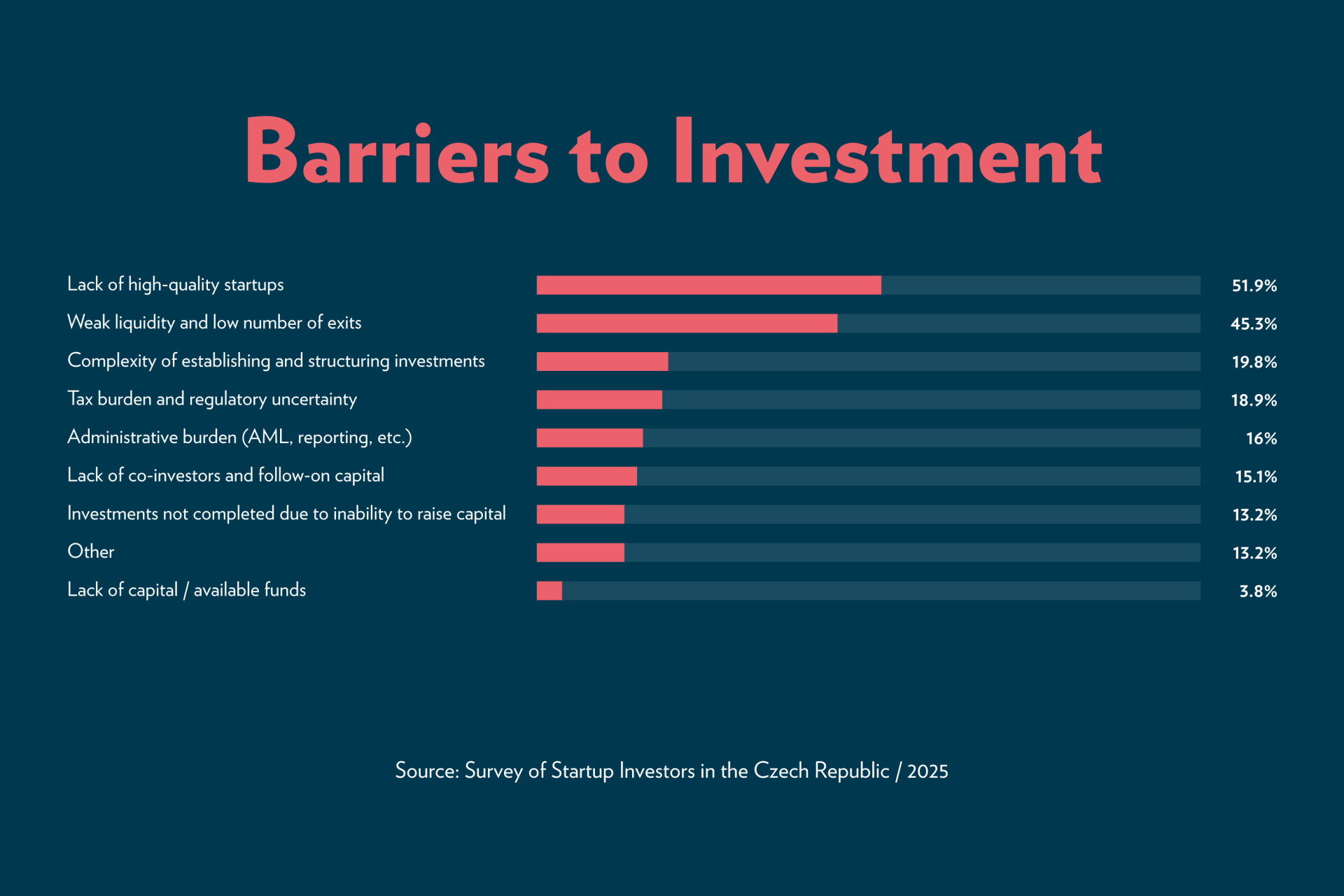
Only 4% of respondents identified lack of capital as a problem.
Slower exits mean that capital remains tied up in existing investments, limiting the recycling of funds into new startups and slowing the overall flow of venture capital.
“The survey data dispel the myth that there is a shortage of capital in the market,” says Eliška Vámošová, author of the survey and Marketing Director at DEPO Ventures. “Many investors are waiting for returns from their existing portfolios, while the number of new investors entering the market remains far below what would be needed to sustain future growth.”
Untapped capital could enter the ecosystem
The survey also highlights a significant pool of potential capital among investors who currently focus on other asset classes.
More than 57% of these respondents say they would be willing to invest in startups if they had better information about the ecosystem. Only 6% say they are not interested in startup investing at all.
However, access remains a key barrier. 42% of potential investors say they simply do not know how to start investing in startups.
Many also point to the need for stronger ecosystem support. Among non-startup investors surveyed:
➡️ 52% would welcome help identifying high-quality startups
➡️ 36% would value opportunities to co-invest
➡️ 31% point to tax incentives as a motivating factor
These findings suggest that unlocking new capital may depend largely on education, community building, and improved access to startup investment opportunities.
Tax incentives seen as key policy lever
Legislation and regulatory conditions are another critical factor shaping the Czech startup investment environment.
Respondents rated the Czech legislative environment 3 out of 5, roughly equivalent to a “C” grade, indicating relative stability but significant room for improvement.
The absence of tax incentives for startup investors remains one of the most frequently cited issues. The survey shows strong consensus across investor groups: 76% of startup investors and 79% of non-startup investors would support tax incentives for startup investments.
Support is similarly strong for enabling pension funds to participate in venture capital. 75% of startup investors support systemic incentives that would allow pension funds to invest in VC or private equity funds.
“The Czech startup investment ecosystem is at a crossroads,” says Jiří Vicherek, Chairman of the Czech Startup Association.
“We’re seeing the lowest inflow of first-time investors on record, and nearly one-fifth of existing investors don’t plan to be active in 2026. At the same time, more than three quarters of respondents support introducing tax incentives for startup investors and pension funds. That’s a strong mandate for change.”
According to Vicherek, enabling pension fund participation could significantly transform the investment landscape even if only a small portion of pension capital were allocated to startup technologies.
Investors are increasingly looking beyond the Czech market
The share of investors focusing exclusively on Czech startups has dropped sharply from 31% in 2022 to just 12.5% in 2025. Instead, investors are increasingly directing their attention to the broader Central and Eastern European region, which 43% of respondents now target. 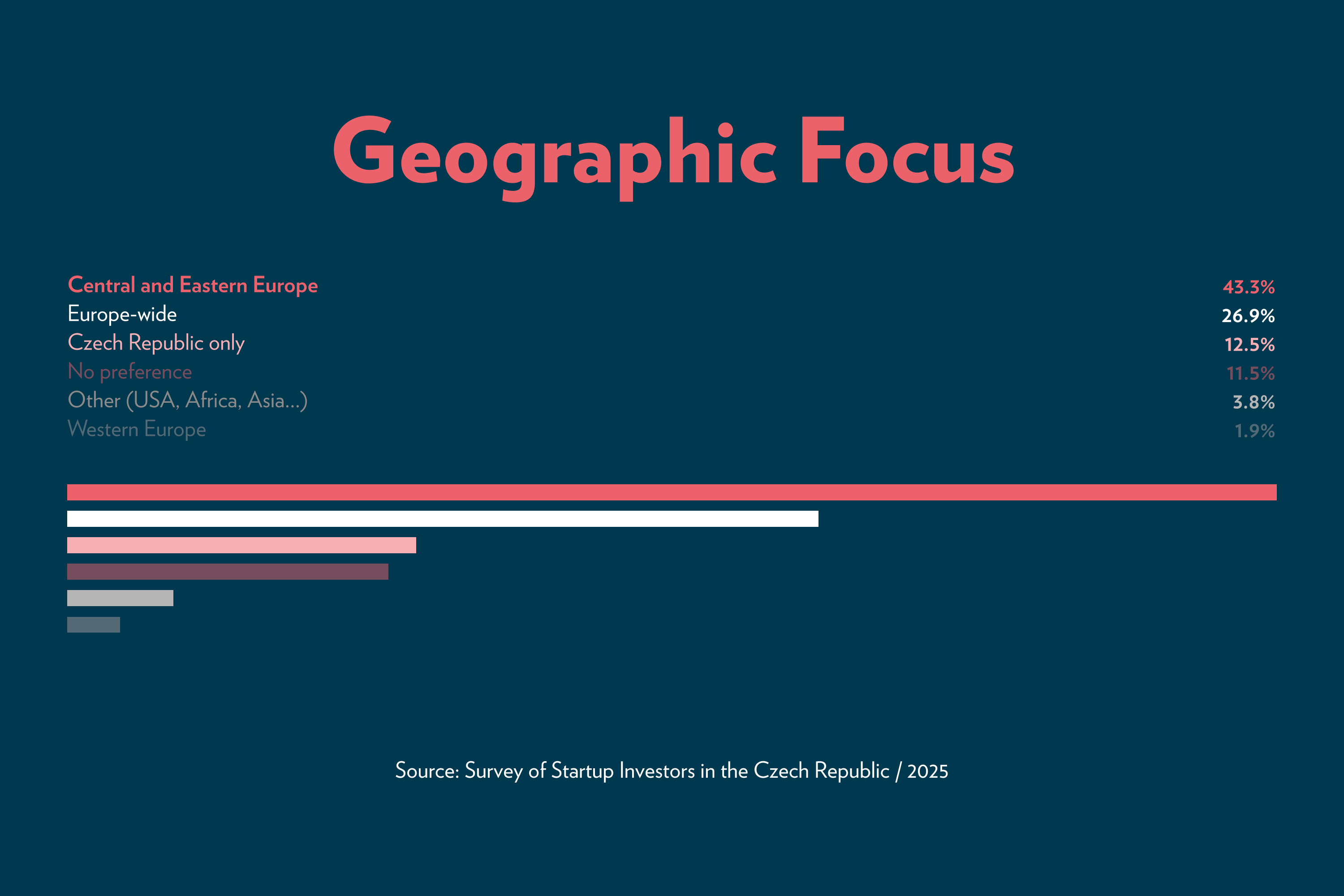
At the same time, investment interest is shifting toward technologies that support Europe’s strategic resilience.
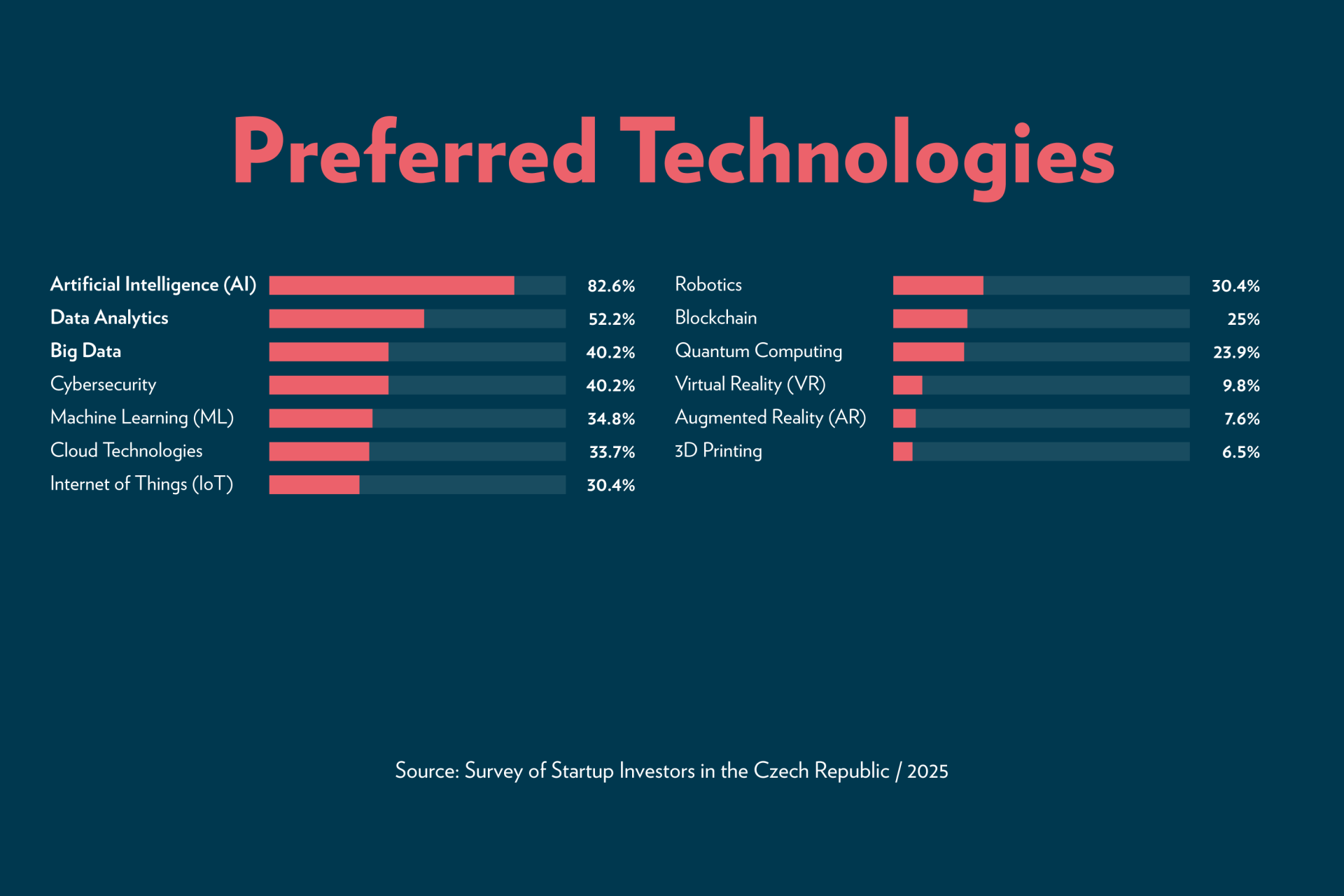
AI remains the dominant investment theme, attracting 83% of investors. Software-as-a-service (SaaS) also continues to perform strongly, with 52% of investors focusing on the segment.
Meanwhile, defense technologies and dual-use solutions (39%) and space technologies (27%) are emerging as fast-growing sectors attracting increasing investor interest.
In contrast, blockchain technology continues to lose momentum, attracting only about 25% of investors after peaking in popularity in 2021.
Structural challenges
According to industry leaders, the Czech venture capital market is gradually maturing, but its growth is constrained by structural limitations.
“The Czech venture capital market is maturing, and investors are starting to think more strategically,” says Petr Šíma, General Partner at DEPO Ventures and Board Member of the Czech Startup Association.
“AI, defense technologies, and space tech are no longer just buzzwords — they’re sectors where the next generation of European technology leaders is emerging. What is really holding us back is the limited supply of high-quality opportunities and insufficient support for startup investing. These are challenges that can be addressed, and we are actively working on them.”
The full 2025 Report can be found here.