


AI Is Boosting Agency Revenue, and Undermining It at the Same Time
For a while, generative AI felt like magic. Click, click, prompt, prompt — et voilà: a social media post. A blog article outline. A campaign idea. For agencies built on knowledge work, it looked like a productivity miracle waiting to be monetized.
Three years into the hype, we’re much more realistic about AI’s limitations. We’ve realized it’s far from magic and its outputs are rarely delivery-ready, regardless of how refined your prompting skills are. So far, AI didn’t eliminate human effort, only redistributed it.
Which makes this a good moment for a status check: Is AI helping agencies make more money, or covertly chipping away at their revenue?
After working on a recent survey of 183 agencies across Europe, the UK, North America, and APAC, we’ve come to an unsatisfying but honest conclusion: it’s doing both. At the same time.
The numbers may look reassuring, but the story behind them is not
When we asked agencies about AI’s impact on revenue, the topline result leaned clearly positive:
- 65% reported a positive revenue impact;
- 27% reported a negative one;
- 34% said they expect a negative impact in the future, even if they haven’t experienced it yet.
At first glance, the numbers look validating. Twice as many agencies are seeing upsides as downsides. It’s tempting to declare AI a net win and move on.
But when you look closer, twenty-seven percent reporting a revenue drop is not negligible. It represents real agencies, with real clients, watching parts of their business model erode in real time. And the fact that more than a third expect future damage tells us something else: even agencies doing “fine” today don’t feel secure.
To understand what’s actually happening, we need to look beyond the aggregate and into the mechanics.
How AI helps agencies earn more — for now
Talking to agencies, we learned that the most common source of positive impact wasn’t new AI-native services or bold innovation. It was plain, unglamorous efficiency.
Agencies reported saving money by:
- Reducing outsourcing (translation, voiceover, basic asset production);
- Compressing internal workflows (research, drafts, summaries, admin);
- Increasing output without increasing headcount.
In practical terms, AI is acting as a margin tool. Work that previously required third-party vendors or additional staff is now increasingly handled in-house. In some cases, agencies are delivering more options to clients in the same time window, strengthening perceived value, at least for the time being.
When efficiency turns into erosion
AI efficiency, however, is a double-edged sword.
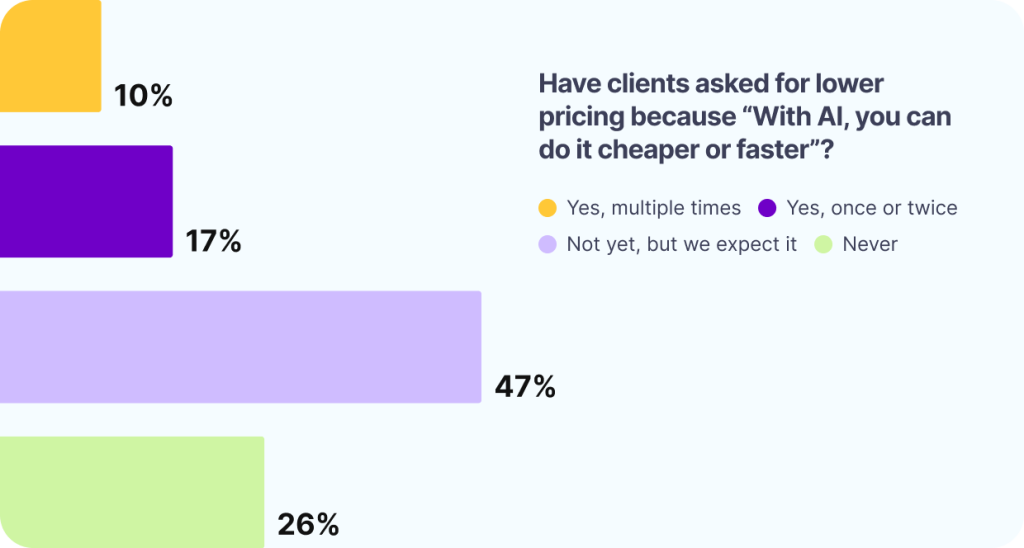
The same gains that boost margins internally can create pressure externally. Clients aren’t blind. They use AI tools themselves, and many quickly assume AI is doing “most of the work.” In our survey:
- 27% of agencies have already been asked to lower prices because of AI;
- Nearly half haven’t been asked yet, but expect to be.
This expectation gap can easily turn into a revenue leak.
Many agencies hold their ground on pricing — and kudos to them. But not all are equally positioned, equally experienced, or equally equipped to do so. Some will reduce scope. Others will accept lower fees and try to make it up in volume. None of these strategies are neutral.
The agencies reporting negative revenue impact weren’t necessarily bad at AI (or client negotiations). In many cases, they were too exposed to services that clients now perceive as automatable: content production, basic creative execution, commoditized strategy outputs.
AI didn’t destroy their work. But it dramatically changed how that work is valued.
Agencies stuck in a paradox
Here’s the tension currently playing out across the industry:
- Agencies need AI to stay competitive;
- Using AI makes parts of their work appear cheaper;
- Cheaper-looking work attracts price pressure;
- Price pressure erodes the very margins AI was meant to protect.
That’s how you end up with a market where most agencies are “doing fine” — and still uneasy.
This also explains a pattern that showed up repeatedly in our data: fear of the future often outpaces present-day damage. Agencies sense that today’s efficiency gains may become tomorrow’s baseline expectation.
Not all revenue impact looks the same
This may be obvious, but it’s still worth stating clearly: AI is not hitting all agencies equally.
Custom software development, complex digital products, and deeply integrated client work show far less immediate pricing pressure. These services still require context, responsibility, and long-term thinking — things AI can assist with, but not replace.
By contrast, services that were already under margin pressure before AI arrived are now feeling it acutely. AI didn’t invent the problem, only accelerated it.
That’s why blanket statements about “AI being good” or “AI being bad” miss the point.
The impact depends on what you sell, and how tightly it’s tied to human judgment versus output volume.
New services help but they’re not a shortcut
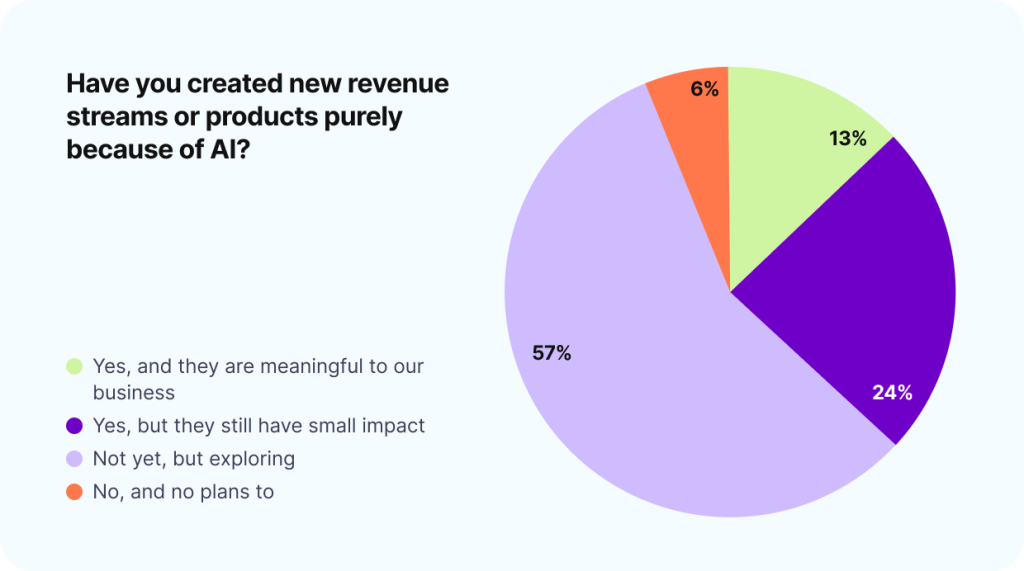
As further proof that the AI-and-agencies story really is a mixed bag, some agencies have launched AI-driven services and seen meaningful success. Our data shows:
- About 13% report strong success with new AI-based revenue streams;
- Another 24% report moderate success;
- The majority are still experimenting.
These wins are real, but they’re not automatic. The agencies doing well here aren’t reselling tools. They’re finding new ways to package expertise: education, integration, workflow design, change management.
And that makes all the difference. AI itself is rapidly commoditizing. The ability to make it useful, safe, and valuable inside a specific business context is becoming the real competitive advantage.
What this means going forward
Some agency services will disappear. That’s unavoidable.
Others will survive but look very different: priced differently, scoped differently, justified differently. And some new services will emerge precisely because clients are overwhelmed, uncertain, and struggling to translate AI potential into business outcomes.
The agencies most likely to stay successful aren’t the ones chasing every new model or feature. They’re the ones re-examining what they sell through the lens of value, not effort.
And the truth hiding behind the numbers is this: AI isn’t simply helping agencies earn more or stealing their revenue. It’s forcing them to decide, sooner than expected, what they actually want to be paid for.