
If you’ve spent any time on LinkedIn lately, you’d think the average IT agency is either a ghost town or a money-printing machine powered by a single ChatGPT prompt. The reality, as it turns out, is far more beige, and significantly more interesting.
A new report on reality of agencies in the age of AI, from Croatian platform Productive, surveying 180 agencies globally, reveals that the industry isn’t collapsing under the weight of automation.
We are witnessing a “quiet period of transition” where the hype is finally meeting the hard reality of the balance sheet. For agency leaders trying to navigate these murky waters, the data (as always) offers to be a lighthouse. If they don’t miss it, they could learn its prime time to stop defending their hours and start defending their value.
The “AI Discount” is coming for your inbox
The most immediate point of the report is, unsurprisingly, the bill. Clients have seen the headlines and are starting to ask the inevitable question: “If a bot wrote this, why am I paying human prices?”.
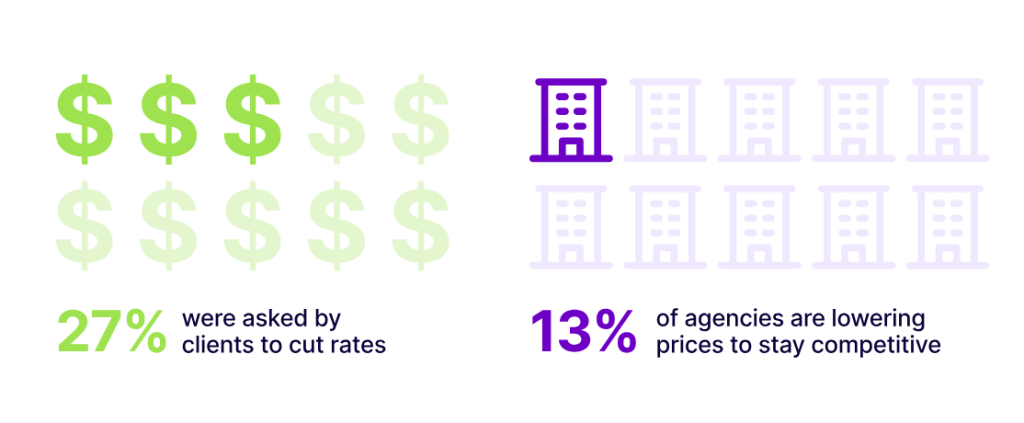
According to the report, 27% of agencies have already been asked for “AI discounts,” yet only 13% have actually lowered their rates. The smartest firms are “owning the narrative” before the client even brings it up. They aren’t explaining their tooling costs; they support their fees in expertise and outcomes.
Tomislav Car, CEO of Productive, suggests that the shift toward value-based pricing is the only way out of this trap. “The conversation shifts from ‘How much does it cost to build a website?’ to ‘What is this redesign worth to your business?’” Car says.
“If the new website is expected to increase revenue, improve conversion, bring in more qualified leads, or shorten the sales cycle, that expected impact becomes the basis for pricing.”
However, transitioning to this model isn’t just a matter of changing the invoice template. Car identifies three major hurdles:
- Agencies are still learning how to best define and quantify value with clients.
- The clients themselves often don’t know what the impact is worth to them or they haven’t measured it.
- The clients hesitate to communicate their budgets or targets to the agency, this is a matter of trust.
“That’s why value-based pricing is still the minority model, even though a lot of agencies have wanted to move in that direction for years, in order to improve their margins.”
The quiet profitability boom
While the media focused on the fear of AI-driven obsolescence, agencies were busy streamlining their operations. A staggering 65% of agencies report a positive impact on their revenue or profitability thanks to AI.
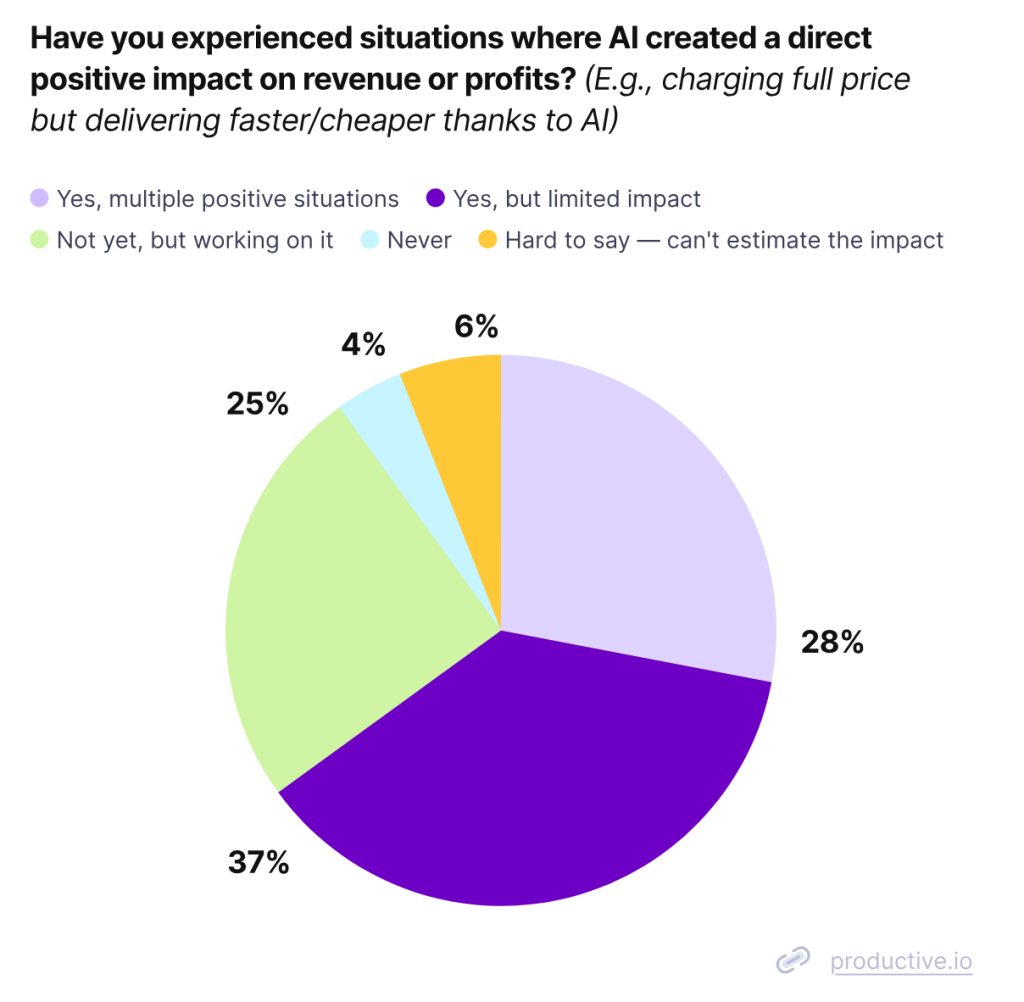
Interestingly, this isn’t coming from a flood of new AI-specific work. It’s coming from “finding new and smarter ways to do the same work“. Agencies are automating the administration stuff: reporting, meeting notes, and proposal drafting, and reinvesting that saved time back into the project to add more value.
The lesson here is simple: efficiency is for the agency to keep, not to pass back as a discount. The firms seeing the biggest margin improvements (nearly half of the successful ones) are those that kept their prices steady while using AI to cut internal production time.
The talent shuffle: Skills over headcount
For those fearing a mass layoff wave, the data offers some relief. Significant staff reductions due to AI are rare, affecting only 3% of surveyed agencies. Instead, we are seeing a “slow rewrite” of the agency org chart.
Agencies are becoming more cautious about new hires, testing how far they can stretch existing capacity before adding headcount. The result is the rise of the “Hybrid Role” — copywriters who are prompt masters and designers who act as AI curators. AI literacy is no longer a bonus skill.
New revenue streams
While most are using AI to save time, a smaller, more adventurous group (about 13%) has managed to turn AI experimentation into meaningful new revenue. Examples include:
-
- AI Consultancy & Education: Helping clients understand the tech they are terrified of.
- GEO (Generic Engine Optimization): A new take on SEO focused on visibility within AI search engines like Gemini and Perplexity.
- AI-Augmented Apps: Creating proprietary internal tools that they then license or use as a competitive moat.
In any case, Car advises agencies to avoid the “shiny object” trap when looking for these new streams. “Start with the problem, not the technology,” he says. “A much better question is ‘What problem do our clients need help solving that they couldn’t solve before AI?’ The agencies that are quick to figure this out will be much better positioned on tomorrow’s market.”
Show me the value!
The “Agency of Tomorrow” looks remarkably like the agency of yesterday, just with better tools and a more honest relationship with value. The market is shifting from “how much time did this take?” to “what did this achieve?”.
To navigate this change, agencies must stop being passive observers of the AI hype. Use the efficiency to boost your margins, re-educate your clients on why they hire humans in the first place, and for heaven’s sake, stop billing by the hour. The machines are fast, but the strategy is still all you.