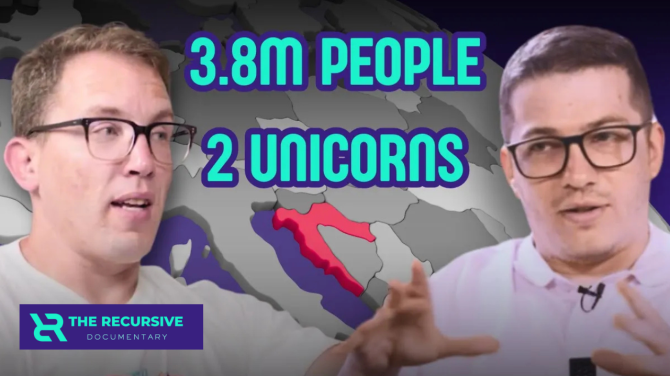


“Keep building” was the slogan of this year’s How to Web conference in Bucharest. To reflect on the European innovation landscape, The Recursive brought together a roundtable of ecosystem builders for a discussion featuring Iwona Anna Biernat (Co-Lead, EU-INC), Vladimira Cincurova (CEO, European Startup Embassy), and Karol Lasota (Partner, Inovo VC), who outlined how Europe can position itself more effectively in global innovation.
A shift toward pan-European cooperation
According to the latest Atomico’s State of European Tech, in the span of a decade, Europe’s tech ecosystem has expanded from under $1T to roughly $4T in combined public and private value, now accounting for about 15% of European GDP compared to just 4% in 2016. The growth has been strikingly steady since 2016, interrupted only by a modest correction after the 2021 peak, and today tech ranks among Europe’s largest engines of value creation, even if policymakers still don’t treat it as such.
Alongside this growth, there’s also been a shift in mindset: Iwona Anna Biernat observed a change in tone within Europe’s tech conversations over the past year. She noted that discussions, especially online, have become more constructive and more focused on working together across borders.
“What’s changed over the past 12 months is that there is a pan-European movement, you have the whole ecosystem coming together and speaking up,” she said.
A key part of this movement is the EU-INC petition, which proposes creating a single pan-European legal entity that would allow founders to operate under one unified standard rather than navigating different rules in 27 jurisdictions. This, Biernat said, would enable faster incorporation and more flexible capital raising.
Iwona also emphasized structural improvements that could support European founders. Biernat highlighted the need for better company-building infrastructure, including faster incorporation processes and more consistent rules across countries.
“A single pan-European legal entity would allow founders to incorporate once and raise capital from anywhere. That’s the level of simplicity we need,” she added.
Early-stage funding remains Europe’s missing piece
About 36% of European VC investment in 2025 went into deep tech, up from 19% in 2021. While the US channels tens of billions into a small group of AI giants, Europe distributes roughly $16B across a wider range of areas such as compute, quantum, defense, mobility, and climate. For deep-tech founders in Europe, the environment is supportive, but expectations around capital efficiency and strategic partnerships remain higher than in the U.S.
Lasota shared that Europe needs more early-stage investors willing to commit at very early stages, including before a formal idea is fully defined. Without this, he warned, U.S. funds will continue to secure many of the strongest European opportunities.
To help close the early-stage gap and support founders expanding beyond Europe, Cincurova pointed to the newly launched European Startup Embassy in San Francisco, a community bridge for CEE founders entering the U.S. market.
“If we link European communities at home and abroad, we create a network where know-how and resources flow freely,” she said. She added that stronger cross-border collaboration, both within Europe and among European communities abroad, can increase access to knowledge and resources.
Lasota closed by noting that founders should feel confident exploring new ideas and opportunities:
“Please do things that feel challenging. Take risks. We’re going to back you. If you fail, that’s okay as long as you want to build something meaningful.”
He shared a simple message:
“Just build stuff… and build in Europe. There is an opportunity, and we should make use of it.”